Wednesday, February 18, 2015

Grimm. (2012). "Cinderella." Grimm's Complete Fairy Tales. New York: Fall River Press.

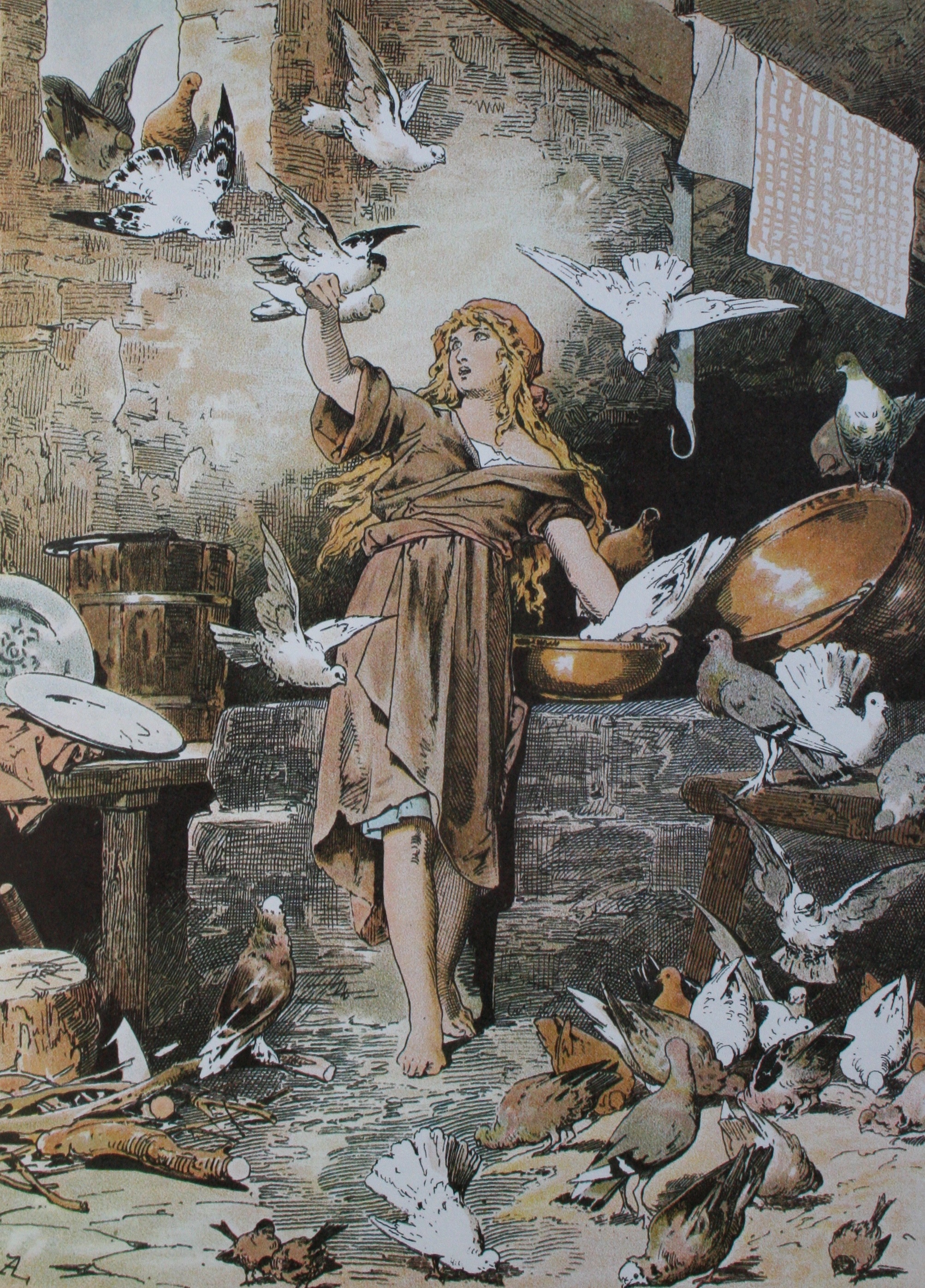
This fairytale has a few things different from the Disney version of Cinderella. Everything remains the same as the Disney version except the following: The father goes to a fair, in which the stepsisters ask him to bring them back jewelry, but Cinderella asks him to bring back the first branch to hit his hat on his way home. She then uses this hazel branch to plant by her mother's grave. Every time she visits her mother's grave her tears water the branch until it turns into a tree. There, a white bird lives that grants every wish she makes while sitting by her mother's grave. In order to go to the festival, Cinderella must pick out every lentil that her stepmother dumped in the ashes within 2 hours. Even though the birds helped her do this, her stepmother says that if she can pick the lentils out of two dishes within 1 hour, then she can have a dress to wear to the festival. When the stepmother fails to carry out the deal, Cinderella goes to the bird by her mother's grave and wishes for a gold and silver dress and silk and silver slippers. The story is the same with her going to the festival except it lasts for three days. On the third night, the prince used "stratagen" to have Cinderella's slipper get stuck as she ran away so that he could use it to find her. In the end, the prince finds Cinderella, and the stepsister's eyes are pecked out by the bird.
I thought this fairytale would be good to use to compare and contrast the Disney version to this original version.
Grimm. (2012). "The Elves." Grimm's Complete Fairy Tales. New York: Fall River Press.

This fairytale had three parts to it, but they all went together. First, there was a poor shoemaker who only had enough leather for one more shoe. After leaving out the leather overnight, he woke to find a pair of shoes perfectly made. Since a customer paid extra for them, the shoemaker was able to buy enough leather for 2 more shoes. The mysterious pattern continued with the shoes being made perfectly at night. Eventually the shoemaker became wealthy enough to pay back the mysterious nighttime shoemakers back by making clothes and shoes for them. After his wife and him stay up all night to find the two small, naked men get the clothes, they never saw them again. The second part of the story holds similar mysterious elves, but this story is about a servant girl who receives a letter from elves asking her to hold a child for a Christening. The elves made her so happy at the Christening that they tricked her into staying "3 days" with them. When she finally is able to return hime, she finds out that her master is dead because it actually had been 7 years! The third part of this fairytale is about a child that is taken by elves and exchanged for a changeling. To get the child back, the people have to boil an egg shell over water to make the changeling laugh.
This fairytale would be tricky to teach, but I thought that it could be taught during St. Patrick's Day celebrations after or before the "leprechaun" came to the classroom to mess up the room.
I also thought a fun activity would be during Christmas to compare these elves to the "Elf on Shelf," and students could make and leave out clothes for the elves.
Grimm. (2012). "The Frog-King." Grimm's Complete Fairy Tales. New York: Fall River Press.

This fairytale by the Grimms Brothers is about the youngest princess that plays with a golden ball. One day, the golden ball falls down a well when the young princess is playing with it. A talking frog makes a deal with the girl that if he gets the golden ball from the bottom of the well, then she must be his companion. However, once he retrieves the ball, the princess leaves him. When the frog enters the castle and tells the king what happened, the king says that the young princess must do as she promised the frog. The princess gets so mad at the frog that she throws him across the room, and a king's son transforms from the frog. He was previously bewithced. The king's son's coachman, Henry, was so sad when he was turned into a frog that he bound his heart. In the end, when the boy was freed, Henry's heart broke with joy.
I think this fairytale could be used to teach children about carryout promises. I also thought a lesson could be taught on "what's on the inside is what counts."
A fun comprehension activity for this fairytale could be reader's theatre in which the students act out the scenes as the story is read aloud.


Zolotow, Charlotte. (1992). The Seashore Book. New York: HarperCollins.

This book begins with a boy who lives int he mountains. He has never seen the seashore, so he asks his mother to describe it to him. The mother takes the young boy and the reader on an imaginative journey to the seashore. She describes every visual and sense that the boy would experience while at the seashore. In the end, the boys opens his eyes feeling as if he really went to the seashore. The images and words used throughout this book is beautiful because it works to successfully describe the beauty one would experience at the seashore all without physically being there.
I loved this book for a visualizing lesson, which is attached:
I also thought that this book would be great to teach the senses since the mother describes different things the boy would see, hear, and feel.
The attached document also contains many activities/ vocabulary/ lessons one could implement. There are so many different things a teacher could do with this book, so I think it would be helpful to choose just one thing to focus on within this copious resource: http://www.doverpublications.com/images/pdf/048649408x_TM.pdf
Book cover

Melling, David. (2002). The Kiss That Missed. Hauppauge, NY: Barron's Educational Series Inc.

This award-winning goofy book is something that children will enjoy reading and laughing along with. The story starts with a busy king who blows his son a kiss, but it misses. The king sends a knight in search for the "missed kiss." On his journey, he comes across many scary creatures. However, the kiss hits every creature and puts them quietly to sleep. When the knight comes across a dragon who chases him, he thinks the dragon is going to eat him. Instead, the dragon just wants to give him a good night kiss. In the end, the knight brings back the good night kiss, and he promises to never be in a hurry. I loved the humor and fun within this story. It is a play on a typical fairytale and knight in shining armor. I also liked how the text on many pages were shaped or curved along the pictures to fit the page's tone. I also thought the cartooned illustrations accurately portrayed the fun humor involved.
I thought that this book would be a fun story to read to young children before a nap time (so preschoolers).
The story could also be read to them by a familiar character from the movie Diary of a Wimpy Kid through this link: http://www.storylineonline.net/kiss-missed/
The following is a link to related activities (art, sequencing, feelings, writing) for young children as well: http://www.playingbythebook.net/2014/02/17/40-activities-to-go-with-several-books-by-david-melling/
Book cover

Tuesday, February 17, 2015

Hill, Laban Carrick. (2010). Dave the Potter, Artist, Poet, Slave. New York: Little, Brown and Company.

This Caldecott award winning book has exquisite, realistic, yet cartooned illustrations by Bryan Collier. The story is about a slave who holds stronger meaning to a simple pile of dirt and pot. It goes through the process of Dave making a single elaborate pot, and it ends with his poem etched into every pot that he makes. At the back of this picture book there are some examples of Dave's poems left on pots. This story is great because it is based off of a true story. I think it would be great to use when talking about slavery because it provides a different perspective of African American's lives during this time. Dave the potter is a slave to celebrate, and some of his pottery remains today. I think this story would be great to use in a young grade's Social Studies lesson. I also think this book would be great to use for a Language Arts/ poetry lesson. It would be neat to have students work with clay and create pots and poems together just like Dave did. I took a ceramics class, so I know how difficult using a wheel is. Therefore, it would be neat to show my students the work I did (and worked really hard on) compared to the beautiful work Dave the potter did. Students could make clay pots with their hands and either write their own poems to go into the pots, or etch their own poems into the pots (depending on the students' age).
The following is a link from The New York Times on more information about the real-life Dave: http://www.nytimes.com/2010/11/07/books/review/Horwitz-t.html?_r=0 This could be used for the teacher to have background information to tell the students about Dave, or if students are older it could be used for students to read on their own.
Book Cover

Madrigal, Antonio Hernandez. (1999). Erandi's Braids. New York: Putnam's Books.

This book is based off a specific time period in a small village in Mexico. Erandi's birthday is highly anticipated, and when her mother and her go into town she looks forward to picking out her very own birthday present in a few days. On their way home, Erandi and her mother hear about a service that collects hair for payment. When Erandi's birthday approaches she fears that her mother has forgotten about her present. She previously had heard her mother mention that they needed a new fishing net, but they do not have enough money for it. Then, Erandi fears her mother is going to cut and sell Erandi's beautiful braids (which she takes pride in). However, as Erandi and her mother approach the man cutting hair, Erandi's mother plans on having her own hair cut for money. In the end, Erandi steps up to have her hair cut for enough money to buy a new fishing net as well as her birthday present.
This book is a great multicultural picture book. The author of this book was born in Michoacan, México, and he tells a beautiful historically accurate story of a specific time period in a small Mexican village, in which many women were forced to sell their hair for money. In addition, Tomie Depaola beautifully depicts Mexican embroidery and elaborate colors through his illustrations.
Cover
The following is a lesson plan using Erandi's Braids as a mentor text to teach a multicultural lesson on story structure: