Friday, March 27, 2015

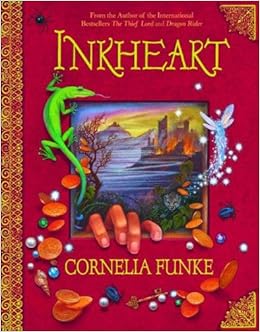
Funke, Cornelia. (2003). Inkheart. New York: Scholastic.

This was also one of my favorite books growing up. This novel is about a young girl named Meggie. One night, her father, a bookbinder, reads aloud from Inkheart. When he reads, something magical happens, and an evil ruler, Capricorn, from the story comes alive leaving the pages into their living room. A strange man, Dustfinger, comes to Meggie's home, and the next day Meggie, her father, and Dustfinger go to Meggie's aunt's home. Later, Meggie's father is captured by a strange group of people taking along Inkheart with them. Meggie is later taken to where her father is captured at Capricorn's. Meggie actually has the real copy of Inkheart. Meggie learns the story of what is happening when her father tells her that he used to have a special gift in which she good bring stories to life as she read them. However, when something came out of the story, someone else went in. The story continues with fight and confusion, and in the end, Meggie has to learn how to control the magic released through her father's storytelling.
The following is a link to a unit plan for this novel: http://www.scholastic.com/teachers/lesson-plan/inkheart-teachers-guide
The following is the link to a video in which students can listen to a passage from the book: http://www.scholastic.com/inkheart/index.htm
The following is a link to activities for this novel: http://librarysparks.com/pdf/librarysparks/2008/lsp_april08__ll_inkheart.pdf
The following is a movie trailer for the film made off of this novel:
Book Cover

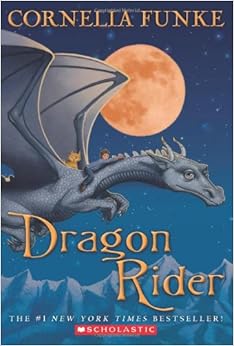
Funke, Cornelia. (1997). Dragon Rider. New York: Scholastic.

Book Cover
This was one of my favorite books in upper Elementary years, and I still enjoy rereading it today! The books begins with a worried group of dragons fearing that humans are going to take over their land. The wisest dragon of all, Slatebeard, warns them all to go to the Rim of Heaven in order to stay hidden from humans, but Firedrake is the only dragon who takes him seriously and begins a journey with his brownie companion, Sorrel. Along his journey, Firedrake must find Gilbert Graytail to collect the map, but in the city he must hide away. Here Firedrake finds a young orphan, Ben. Ben wants to help Sorrel get the map. Sorrel is a little leery and sour towards "the enemy kind" like Ben. From then on, the three companions continue on the journey together encountering many characters along the way. Nettlebrand, the villain, and his worker, Twigleg, find out the boy has two of Nettlebrand's scales. In the end, the three companions must discover the secret destiny to save the dragons.
This novel could be used for an upper elementary novel study, in which students perform character evaluations and study the plot. A fun activity that I thought would be good for this novel would be to rewrite a part of the story through the villain's, Nettlebrand's, perspective.
The following is a link to 4th grade discussion questions for this novel: https://multcolib.org/dragon-rider

Monday, March 23, 2015

Hesse, Karen. (1997). Out of the Dust. New York: Scholastic.

Book Cover
This novel is about a girl, Billie Jo, living in Oklahoma during the Dust Bowl years of 1934-1935. The beginning of the story focuses on her father's wish for a son, but is stuck with loving her, a daughter. The family also is affected by dust storms that harm the family farm in which Billie Jo lives on. A big fire happens from a kerosene lamp, in which Billie Jo tries to help by throwing it out of the house, but she accidentally hits her mother. Her mother is saved from the fire, but she does not ever look like herself again. Later, both her mother and newborn baby brother, Franklin, die from childbirth. As Billie Jo begins to suffer separating herself from her father, she ends up leaving "the dust." Billie Jo learns her lesson of family and belonging from a man she meets while hitchhiking. In the end, she returns home and calls her father "Daddy" for the first time since her mother's death. The dust storms end, and her and her father begin to gain closeness again.
This story would be perfect to teach about the hardships of the Dust Bowl years. It is a subject not often taught or discussed within Elementary Education, so I think it would be neat to use this novel to discuss life during these years. It would also be good to incorporate a discussion on family importance and belonging. Another thought I had would be to teach this around Thanksgiving and teach children that even within the hardest of lives, we can find something to be thankful for.
The following is an example of a 6th grade unit for this novel: http://www.louisianabelieves.com/docs/default-source/teacher-toolbox-resources/unit-plan-english-language-arts-grade-6-sample-out-of-the-dust.pdf?sfvrsn=7
The following is an example of a history lesson for this novel (I like this because I can learn along with my students): http://www.loc.gov/teachers/classroommaterials/lessons/dust/index.html
Hansen, Joyce. (2006). I Thought My Soul Would Rise and Fly: The Diary of Patsy, a Freed Girl, Mars Bluff, South Carolina, 1865. New York: Scholastic Inc.

Book Cover
This book is about a young, handicapped girl, Patsy, living as a freed slave after the Civil War. She is upset when she realizes her former master, Davis, does not keep his promises of money, land, and education for his former slaves. She begins to learn new chores, such as cooking from other former slaves. Later, Patsy ends up teaching other former slaves since Davis did not keep his promise of providing his former slaves with an education.
I would use this novel to talk about slavery. I would use it to introduce the Civil War, and I would also use it to teach about what happened even after slavery was abolished.
The following is a Scholastic guide for teachers with comprehension questions, discussion topics, and activity ideas for this novel: http://www.scholastic.com/teachers/lesson-plan/i-thought-my-soul-would-rise-and-fly-discussion-guide
The following is the link to the "Dear America" website on Scholastic with more books within the series and activities: http://www.scholastic.com/dearamerica/
Denenberg, Barry. (2001). Early Sunday Morning: The Pearl Harbor Diary of Amber Billows, Hawaii 1941. New York: Scholastic Inc.

Book Cover
This book is set up like a diary belonging to a 12-year-old girl, Amber, living in Hawaii in 1941. The story depicts her experiences throughout the bombing of Pearl Harbor. The story begins when she is forced to move to Hawaii because of her father's job. She is finally beginning to adapt to her new home, making friends and joining theatre. Her friend and her are even excited about a dance that is going to be on December 7. However, her new life is completely shaken with the Attack on Pearl Harbor in December 7. She recounts the horrific events and her life during and after the attack. She even has a friend, Kame, who struggles being Japanese in America after the attacks. in the end, she stays friends with Kame, but she is relieved to leave the devastation when her father says they are moving back.
This historical novel is perfect to incorporate teaching about Pearl Harbor. This could also be a good novel to begin a unit on the following war.
The following is a teacher guide containing discussion questions, vocabulary words, and student activities for this novel: http://www.scholastic.com/teachers/lesson-plan/early-sunday-morning-discussion-guide
Another great activity idea would be to teach about diary writing and have the students create their own historical diary. Teachers could simply teach diary writing and have students write their own diary (younger students), or for older students, teachers could have students create a historical diary for the current year, updating entries using current events in the news.
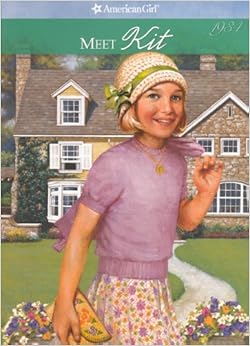
Tripp, Valerie. (2001). Meet Kit. Middleton: American Girl Publishing.

This beloved book is about a young girl, Kit Kittredge, growing up during the Great Depression in the 1930's. Her wealthy family is hugely affected by the bank crashes, which causes her family to adapt to such conditions. Her family ends up opening their home to be a boarding house. Throughout the series of Kit books, Kit continuously looks for different ways in which she can help her family during such hard times. In the mean time, she acts as a normal 9-year-old as she strives to be a newspaper reporter. Along with her dog, Grace, and friends Ruthie and Stirling, Kit experiences many struggles a typical 9-year-old may have experienced during the Great Depression.
I think this book series would be great to incorporate to teaching the Great Depression. These books would be relatable to compare students' lives now compared to a child the same age during the 1930's. Terms such as boarding houses, hobos and more could be taught.
In addition, Kit loves Amelia Earhart, so a lesson about her could be incorporated as well.
Similarly, Kit loves to write, so a lesson or activity in which students create their own class newspaper would be awesome to incorporate.
Finally, Kit loves to read, and her favorite book to read is Robin Hood. Therefore, a class read aloud of that would be great.
The following is a link to a resource containing discussion questions and much more for this novel: http://www.americangirl.com/corp/pdfs/Kit_OnlineCurric.pdf
The following is a book trailer for this novel:

Book Cover
The video above is a trailer for the film inspired by Valerie Tripp's Kit books.
Curtis, Christopher Paul. (1999). Bud, Not Buddy. New York: Scholastic Inc.

This book is about a young boy who enters a foster home with the Amoses. Unfortunately, Bud encounters the Amoses's son, Tod, who teases him calling him "Buddy." When Bud fights Tod, he is punished. Bud escapes his punishment, gets revenge on Tod, and runs away from the Amoses home. He meets his friend, Bugs, and they leave together to go West. However, Bud is unable to hop on the train with Bugs, so he begins walking on his own journey. Throughout his journey to Grand Rapids to meet his father, Herman E. Calloway, Lefty Lewis assists him. Bud ends up discovering that Herman is actually his grandfather, and he is not very kind towards Bud. However, in the end, Bud receives a horn from his grandfather's band, which gives him great hope. He also finds out that his bed is actually the bed of his Mother who died.
This book is historical fiction. Therefore it would be great to implement in a classroom in order to teach the history within it. This book takes place during the Great Depression. It would be beneficial to do a unit using this novel in order to teach Social Studies on the Great Depression. Orphanages and foster care were very common in the 1930's, so conversation about that could be implemented during the unit as well. It might also be beneficial to discuss black relations during the Great Depression through this novel.
The following is a book trailer for Bud, Not Buddy:
The following is the link to a whole page on Pinterest on teaching this novel: https://www.pinterest.com/sec_solutions/teaching-bud-not-buddy/