Tuesday, April 7, 2015

Frank, Anne. (1947). The Diary of a Young Girl. New York: Doubleday & Company.

This book is a classic for all upper elementary students to read. This book is a diary of a young Dutch girl, Anne. The diary is kept from the two years that she is hiding while the Nazis are in control of the Netherlands. Within her diary she wishes for a best friend that she can share her secrets with. She begins the diary with a suiter whom she is not super fond of quite yet. During hiding she thinks that true best friend may eventually be Peter. However, it turns out that throughout her lifetime, her only true friend is her diary. Throughout Anne's diary, readers see her close relationship with her father, her distant relationship with her mother, and her admiration of her sister. As many students this age may relate, Anne becomes the chatterbox of her hideout. In the end, Anne dies in a concentration camp, and her diary was later found and published as a historical, nonfiction text.
This novel would be perfect to teach the history of concentration camps because it gives an insider's account.
This also could be used to teach diary writing and format.
Book Cover

Monday, April 6, 2015

Silverstein, Shel. (1974). Where the Sidewalk Ends. New York: Harper and Row Publisher.

This fun poetry novel is essential for every child to be exposed to at some point within his or her lifetime. I think the poems within this novel are good for 3rd grade and above in order for the children to understand its humor. The collection of poetry contains poems about many childhood concerns and just plain goofy poems. Whether it is read to students after recess or during library time, this novel should be read to all students. In addition, I think other poetry collections by Shel Silverstein should also be read to students. Therefore it would be beneficial to do an author study on Shel Silverstein. Or, I think it would be neat to read a new poem within this book (and others by Silverstein) every morning, after recess, or at the end of the day for a whole year with 3rd graders or above.
Besides a simple, fun read aloud, this novel could be used to introduce students to a unit on poetry. Students could learn to imitate the fun, free verse and rhyme Shel Silverstein uses within his writing.
Book Cover

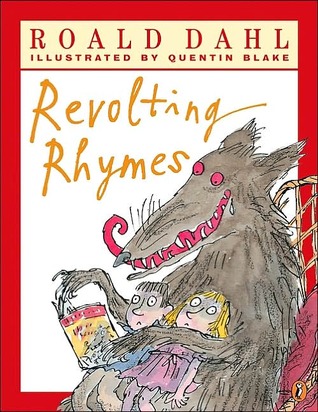
Daul, Roald. (1982). Revolting Rhymes. London, Jonathan Cape Publishing.

This goofy poetry novel is a parody of six classic folktales/fairy tales. Without giving any of the surprise, new endings away, Daul rewrites the endings with twists to the classic Cinderella, Jack and the Beanstalk, Snow White and the Seven Dwarfs, Goldilocks and the Three Bears, Little Red Riding Hood and the Wolf, and The Three Little Pigs.
Roald Daul books were always one of my favorites growing up, but I had never read this humorous, short novel until now. I think this book would be great for students, and I especially think young boys would enjoy the humor within this poetry book. I think this book would be a great, fun, and engaging way to start off a Roald Daul author study. Either that, or this book could be read to students in order to get them interested, and then I could suggest more of Roald Daul's great classics that many students would love. I think he is a great author to encourage the reading of young boys.
Another suggestion for this novel would be for students to choose a classic fairy tale or folktale not used within Daul's novel and have students write their own alternate ending!
The following is the video for one of the poems within this novel (The Three Little Pigs):
 The video above is another video to go along with the novel for Jack and the Beanstalk.

Book Cover
The video above goes along with Cinderella.
 
The video above goes along with Little Red Riding Hood.
Lear, Edward. (1871). The Owl and the Pussycat. Germany: AbeBooks.

This novel is written in poetry for children. This poetry stories contain four main characters, the owl, pussycat, pig, and turkey. This love story between the owl and the cat begins with the two traveling by boat, in which the owl serenades the cat. They finally land in a land full of Bong Trees. There, the owl and the cat find a pig who has a ring they buy off of him. Finally, the two are married by a turkey. This fun, heart warming novel of poetry is perfect for young students.
I thought this poetry book could be used for very young students since it is a classic. This happy poetry book could be used as a nap time story as students' first introduction to poetry.
The following is a teacher guide for nursery rhyme activities to go along with this poetry book: http://www.dltk-teach.com/rhymes/owl.htm
The following is another link to activities and questions for this poetry novel: https://docs.google.com/a/saintmarys.edu/document/d/1_r5u4ItB9DbXQxXG5SmcGBIUSwgFoYnLx0R9HdsW-zQ/edit
The following is a video of the poem being read:


Book Cover
Milne, A.A. (1924). When We Were Very Young. New York: Penguin Publishing.

This fun loving book of poetry is a classic for younger students. This novel contains many poems written by the famous author, A.A. Milne. This poetry novel begins with young readers imagining who they are within the book. Perhaps they are Christopher Robin, or perhaps another character. The 38th poem within this novel was the very first introduction of Winnie the Pooh, who was first known as Mr. Edward Bear.
I thought this great novel would be great to use for an Author study on A.A. Milne for Kindergarten or first grade. I thought it would be a great introduction to poetry for young readers as well. Many of the poems within this novel are fun loving characters, so it may be fun to discuss different topics such as friendship, politeness, animals, and more features within this novel. In addition, many of these poems were written to go along with songs, so I thought it would be neat to try to find such music and incorporate it with the poetry reading.
The following is a video children can listen to of a reading of Winnie the Pooh's first appearance from this novel:

Book Cover

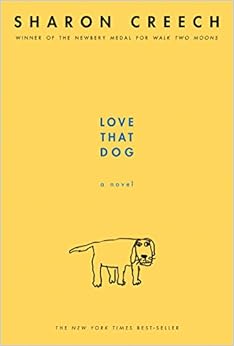
Creech, Sharon. (2001). Love That Dog. New York: HarperCollins.

This humorous poetry book for students is about a boy who dislikes poetry in school. Each free verse "chapter" within this book is like a diary entry written by the boy, Jack. Throughout the poetry novel, Jack continuously dislikes his teacher's poetry assignments. However, as the novel continues, Jack becomes a better poetry writer, and readers can see his poetry develop. In the end, he just might begin to learn to enjoy poetry.
This novel is an easy read for older students, and it is a great entry into poetry for students. The humor within Jack's poetry is relatable to students that may find poetry daunting. As Jack grows, readers can grow in poetry writing as well. I thought a good activity for students with this novel would be to start their own free verse poetry diary just like Jack. I also thought another activity would be to analyze Jack's poetry progress throughout his diary entries since his writing progresses.
The following is a link to Sharon Creech's website: http://www.sharoncreech.com/books/love-that-dog
The following is is a link to a literature guide for teachers for this novel: http://teacher.scholastic.com/clubs/pdfs/lovethatdog_t.pdf
Book Cover

Friday, March 27, 2015

Dixon, Franklin W. (1927). The Hardy Boys: The Tower Treasure. New York: Penguin Publishing.

This mystery is the first novel in the beloved series The Hardy Boys. This mystery begins with Frank and Joe Hardy almost being hit by a car with a man wearing a red wig. Later that same dying criminal says that his loot is being hidden in "the tower." Both towers in the mansion are searched, but they find nothing. The Hardy boys must find the clues to solve the mystery to find the loot and save the name of his friend's father.
This book should also be read as a read aloud because it is another classic mystery for young readers. This book would be great to introduce to young boys especially in order to get boys interested in reading early.
The following is the link to the Hardy Boys' website: http://hardyboys.us/
Book Cover